Late in 2020, finding myself with paid time off to kill, I decided to use it helping the Georgia Democrats in the December special election campaign. That highly rewarding experience (I both canvassed in Atlanta and served as a blue poll watcher on very red territory) is a tale for another time. But in mid-November, three days after I bought  my ticket, I set down the opening paragraphs of the first entirely new fiction I’d written in almost 20 years, which eventually became What You Can’t Give Me.
As I was biking to the office that morning—we were still all-remote but I was going in twice a week to use the gym and get out of the frickin house—I was astonished to find myself writing in my head. This hadn’t happened since 1990, when the openings of at least half a dozen of the stories in my first collection, The Light of Home, came to me on my long walks to and from work. I’d never experienced anything like that before and assumed I never would again. But there I was 30 years later, riding along Memorial Drive and thinking “The most unusual thing about her, in some ways, might have been her three-legged dog …”. And so on.
Fortunately, at 62 I’d achieved sufficient basic wisdom to take the astonishing in stride. That first draft, I find, came to about 650 words, which seems like really a lot for a 10 minute bike ride (“oh yes, I bike 65 words per minute”) so I assume most of it was written sitting down. But I’m certain that at least the first paragraph was revealed to me in transit, and it led smoothly to the rest.
By the time I got on the plane a month later I had six pages of a story and absolutely no clue what came next. But I told myself (I guess the wisdom thing again) “I’ll finish it in Georgia” and that’s exactly what happened. The evening after my second day of door knocking in Sandy Springs and before my first shift at the polling place in Rome I set up the final scene, and a couple of evenings later, after several increasingly bizarre extended conversations with my affable Republican counterparts (well the one with the gun on his hip was not so affable), I wrote it to the end—an end I liked very much but could never have anticipated. And sat there thinking oh my god, I’m writing again.
Why did it play out this way? What got me going after publishing three books, having my career suddenly collapse, being humiliated by years of constant rejection into not writing at all for a decade, recovering to the point of revising and self-publishing three of my unpublished novels, and spending the last couple years thinking “oh well, maybe I’ll write another someday”? As 2021 rolled out and I found myself producing story after story, I realized that choosing to help the team in Georgia had been an intuitive attempt to fight my stress and dismay over the many Enormous Problems It’s Impossible To Do Anything About we were all so oppressed by even before the lockdown hit, an outgrowth of what has to be the most important and hardest-won wisdom of my latter years: the recognition that no narrative has ever lived that cannot be changed. Refusing to be helpless is powerful magic indeed. And recently, as I’ve readied the book for publication, I’ve been thinking about the strange and profound sort of helplessness we’ve all felt during the pandemic—many far more severely, for far more serious and painful reasons, than I and my fellow fortunate ones—and our infinitely varied attempts to keep it at bay long enough to reestablish some part of the life we remembered.
I did not set out to create “pandemic stories” or to convey how my protagonists saw the shared crisis; I was just writing what came to me. After I had accumulated a few it occurred to me that maybe they were stories about how these people saw themselves during that crisis. But I now understand that, terrible as the consequences have been for so many and surreal as the experience has been for virtually all of us, it’s ultimately the same old battle against helplessness—the helplessness of being persistently sick or in pain, of not having the rent money, of being mistreated and held back because of the way you look, speak, love, or see yourself, of feeling down or frustrated all the time and not knowing why, of grief and a million other miseries. In other words the unalterable nature of our existence, which is always about how we see ourselves, every minute of every day.
These are simply tales of people’s lives. The pandemic has served me well as a framing device because it slapped the whole world across the face, all at once, with a particularly cold, harsh, and stinking helplessness akin to a large dead fish, bringing into very sharp focus our ongoing disappointment in our inability to change so many of our circumstances. But if it’s not one reason to feel helpless it’s another; we all know that. These tales turn on unanticipated events that reach happy or sad moments just before they stop and are sure to change after, for better and for worse. The pandemic has been like that, yeah, but at the deepest and most meaningful level it isn’t anything new; it’s what we’re all faced with all the time, notwithstanding the illusion that we can know what’s coming, that we have any kind of grip on what happy and sad even mean.
The wonder of fiction is that it can take an often overwhelmingly opaque and unknowable experience, being human, and make it transparent and comprehensible, reassuring us that maybe we can get a leg up on it now and then. I have always loved short stories for the way their limits—believe me, the authors don’t know any more than you do about what happened before the beginning or what comes after the end—can cut life down to size, disarming it and making it, for a little while, easier to get next to and examine. Turns out entering utterly unfamiliar territory during an utterly shocking world-historical event to make a tiny contribution to a collective effort with an utterly unpredictable outcome got me started on them again. Which is a gift I don’t need to understand any better than that; it’s enough to be grateful, which I very much am. There is nothing I could be gladder to have than a fresh opportunity for you to read what I’ve written. And if you do, I hope you too will be glad.
R.C. Binstock
September 2022
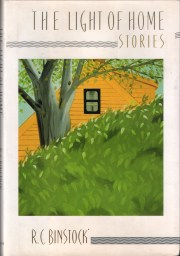 boss to let me work a 30-hour week–for publication as a book. Ann Beattie, my mentor and one of the most well-known short story writers in the country, offered a blurb that called them “among the best stories I’ve read in years”. Someone at Atheneum, not sure who, found a wonderful title, The Light of Home, in a line from one of the stories, and the design people came up with a fabulous cover, featuring an Alex Katz painting (I still love looking at that cover, all these years later). And when it came out, in 1992, it got some lovely reviews. Booklist said the collection “expresses the particular tenor of our time”. My stories! Can you imagine? A one-sentence review in the Anniston, Alabama Star called me “an amazing new writer”. The Boston Public Library bought four copies.
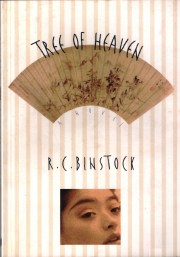 But wait! There’s more! I wrote another, better novel, Tree of Heaven. I got an agent. Tree of Heaven won something called the Washington Prize for Fiction. We got a deal with Soho Press–in fact a two-book deal, I was already almost done with my second novel (OK, third, but who’s counting?). Soho’s publicist went to work. When the book was published in 1995 the reviews were tremendous. High praise in Publishers Weekly, the New York Times (weekday and Sunday), the LA Times, the Boston Globe. Maureen Corrigan called it “a triumph of imaginative empathy” on NPR. I was on the radio, I was on the cover of the Boston Sunday Globe Magazine. And sales, while not tremendous, were adequate. It looked like I had made it for sure this time.
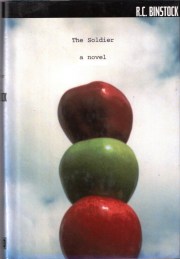 about the second book–the title (The Soldier was, to them, extremely infelicitous), the chapter they wanted me to drop, the hints they wanted broadened or removed, and so on. A couple of the reviews were mixed and sales were poor. And when I sent them the new novel I was working on, Swift River, it was Lee and the first novel all over again. For reasons that still escape me I responded to having been fired by Soho by firing my agent, Nikki Smith, who was always totally on my side. The Career as a Writer was all gone.
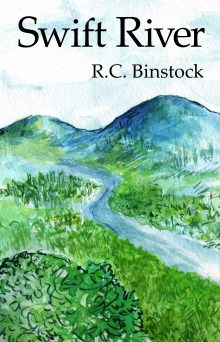 brave new book world and 84 incredible Kickstarter backers who let me know in an unambiguous way that they wanted it to happen, I can publish it myself, which I will in November. A friend and I created the interior design, my daughter and I are making the cover, I hired a sharp young guy to help me get this web site going. No publicist, true, and we’ll have to see how many prepub reviews I can drum up, but that doesn’t touch the important thing: Swift River will be published and those who want to read it can read it. Maybe no one will, maybe it will be a big success, most likely somewhere in between but I am proud to tell you that I can truthfully say, it doesn’t matter. What matters is finishing the book and publishing the book. That’s it. An ebook version of Tree of Heaven is next, and then I might take up one of the other unpublished novels. Or even write another!
 R.C. Binstock Books